

Timotei Popa – șeful promoției 2010-2014 a Institutului Teologic Baptist București
Timotei Popa din Deva este șeful promoției 2010-2014 a Institutului Teologic Baptist din București.

Partajează asta:

Baptiștii din intreaga lume se intalnesc în Izmir
Peste 300 de lideri, pastori, teologi, președinți de seminarii, profesori si credinciosi baptisti din intreaga lume se intalnesc în Turcia pentru părtășie, închinare, studiu și aspecte decizionale. Intalnirea anuala are loc in Izmir, cunoscut in Biblie sub numele de Smirna in perioada 6-12 iulie si include si întâlnirile Consiliului general si al Comitetului Executiv, cele doua organe de conducere ale Aliantei Mondiale Baptiste. Romania va fi reprezentata de Președintele Uniunii Baptiste, Otniel Ioan Bunaciu, de Secretarul general Ionel Tutac si de Vicepresedintele Ilie Tinco.
Anul acesta se vor lua in discutie alegerea noului Președinte al Alianței Mondiale Baptiste si a celor 12 vicepreședinți care vor sluji in perioada 2015-2020. De asemenea, premiul pentru Drepturile Omului Denton Lotz si Janice Lotz va fi acordat lui Ilie Coada din Moldova pentru lucrarea sa in ceea ce priveste stoparea traficului de persoane si a sclaviei sexuale din tara sa. Citeste mai departe pe site-ul Revistei Creștinul Azi»
Partajează asta:

Promoția 2010-2014 a Institutului Teologic Baptist din București (fotografii)
Prin harul Domnului în sesiunea iunie 2014 au finalizat studiile de teologie la nivel de licență o nouă generație de studenți. Fiind prezent la Institutul Teologic am împărtășit cu studenții prezenți bucuria de a se vedea absolvenți. Pe fețele și în atitudinea acestora s-a putut observa și responsabilitatea a ceea ce însemnă lucrarea lui Dumnezeu.
Mai jos postez o serie de fotografii realizate cu acest prilej.
Absolvenții formei de învățământ cu frecvență (zi)

De la stânga la dreapta: Adrian George Alboiu, David Lavric, Cristian Tănase, Raich Robert, Iulian Banari, Timotei Popa (șeful promoției), Marius Chende, Daniel Stoica
Absolvenții formei de învățământ la distanță (ID)

Dragoș Hogaș, Adrian Lauran, Bebi Prică
Absolvenții Institutului Teologic Baptist, sesiunea iunie 2014 – învățământ cu frecvență și învățământ la distanță

Absolvenții Institutului Teologic Baptist, sesiunea iunie 2014 – învățământ cu frecvență și învățământ la distanță împreună cu rectorul instituției, decanul, directorul de departament și coordonatorul formei de învățământ la distanță.

Albumul foto este disponibil aici www.facebook.com/istorieevanghelica/media
Partajează asta:

George Slev – primul intelectual român care a trecut la confesiunea baptistă

Despre George Slev, profesorul și pastorul Ioan Bunaciu scrie într-una din cărțile sale că acesta era un dascăl român, din Aciuța, județul Arad, care a îmbrățișat credința baptistă în anul 1900.
Pe tabloul lui Gheorghe Slev se menționează că este un învățător convertit fiind primul scriitor baptist român, dar și un devotat misionar.
În scurtul portret biografic al dascălului George Slev, profesorul Ioan Bunaciu menționează următoarele:
„E primul intelectual român care a trecut la religia baptistă. (s.n.) A predicat Evanghelia pe Valea Crișului Alb, a tipărit cărți cu caracter religios dintre care cea mai importantă este Evanghelia și Focul.
Evanghelia și Focul a fost redactată la Aciuța în 1906 și apoi tipărită la Detroit. Cartea cuprinde explicarea unor doctrine biblice ca: Biserica Domnului, Botezul Domnului, Crucea Domnului, Despre jertfă, despre post, Despre sărbători etc.
<În 1903 a redactat și a editat cartea de cântări comune cuprinzând 343 cântări (Alexa Popovici, Curs de istoria baptiștilor din țara noastră, p. 78 Curs în manuscris)>”
Sursa: Prof. Dr. Ioan Bunaciu, Propovăduirea în Bisericile Creștine Baptiste, Editura Comunităților Creștine Baptiste din Republica Socialistă România, București, 1976, p. 228.
Fiindcă numele de Slev îmi era cunoscut am găsit că între anii 1924-1925 directorul Seminarului Teologic Baptist din București a fost Prof. Toma Slev, care cred că făcea parte din aceeaşi familie cu George Slev.
Partajează asta:

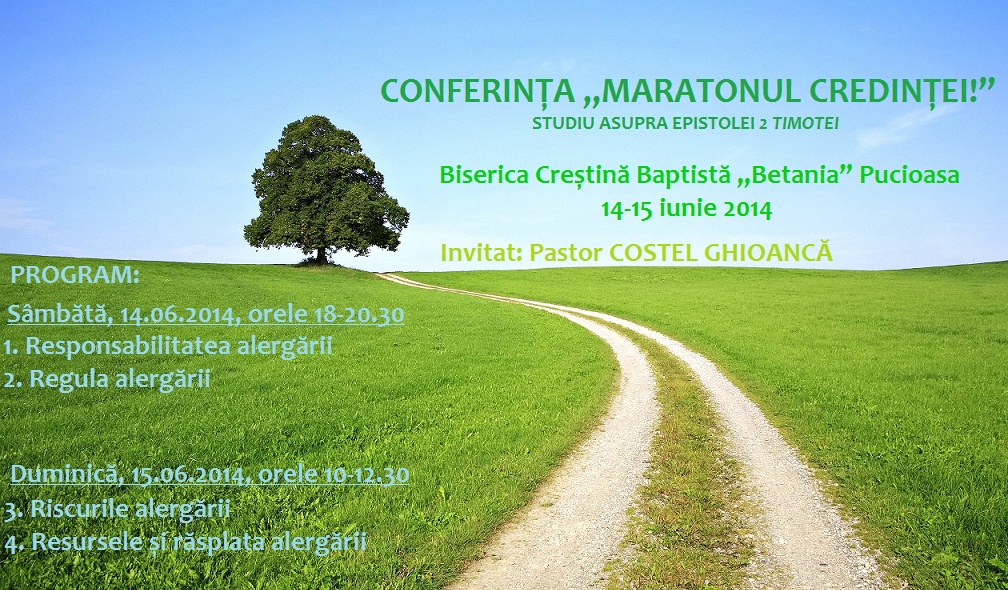
Conferința „Maratonul Credinței!” – Biserica Baptistă „Betania” Pucioasa 14-15 iunie 2014
Partajează asta:

9 THINGS YOU SHOULD KNOW ABOUT THE SOUTHERN BAPTIST CONVENTION
Joe Carter for http://thegospelcoalition.org/
This week the Southern Baptist Convention meets in Baltimore, Maryland for its 156th annual meeting. Here are nine things you should know about America’s largest Protestant denomination.
1. The name Southern Baptist Convention refers to both the the annual two-day convention and the decentralized organization comprised of 46,034 autonomous, local churches and 15.9 million members.
2. The Southern Baptist Convention (SBC) is a network of autonomous churches voluntarily banded together at state, regional, and national levels to engage in missions and ministry activities designed to fulfill the Great Commission (Matthew 28:19-20). Each church in the SBC is an autonomous local congregation of baptized believers that makes their own decisions on staffing, budget, programs, etc.
 3. In 1814, Baptist churches in the U.S. joined together to create the General Missionary Convention of the Baptist Denomination. By 1845 the churches were divided over the issue of slavery. As church historian Miles Mullin explains, southern Baptists desired to make slavery a non-issue, while abolitionist forces in the North (and among northern Baptists) desired the convention to take a moral stand against it. The following year group of representatives from Southern churches created a new denomination, the Southern Baptist Convention.
4. In 1995, on the denomination’s 150th anniversary, the Convention voted to adopt a resolution on racial reconciliation that apologized for its racist roots, for condoning and perpetuating individual and systemic racism, and committed to eradicate racism in all its forms from Southern Baptist life and ministry. At its annual convention in 2012, the SBC elected as president Fred Luter Jr., the first African American to hold the position.
5. The SBC is directed by representatives of Southern Baptist churches, called messengers, who meet once a year for two days to adopt a unified missions and ministry budget called the Cooperative Program allocation budget, elect trustees to oversee the ministry entities of the Convention, receive reports from the SBC entities, and transact the business of the Convention.
6. The primary doctrinal statement for the SBC is the Baptist Faith and Message 2000, which outlines what the denomination believes about eighteen topics, including the Scripture, God, man, Jesus, salvation, baptism, and the church.
7. The principal means by which Southern Baptist churches fund their respective state convention ministries and the missions and ministries of the SBC is through the Cooperative Program (CP). Established in 1925, the CP depends upon the undesignated gifts given to it by Southern Baptist churches. By unifying the funding, the CP provides a workable way through which tens of thousands of like-minded churches can cooperate for the advancement and application of the gospel.
8. The SBC is comprised of the following entities: six seminaries; an International Mission Board, which sends and supports missionaries all over the world; an Ethics and Religious Liberty Commission, providing resources and leadership on ethical issues; Guidestone Financial Resources providing financial planning, insurance, and annuities for church and denomination staff members; a North American Mission Board, supporting the state conventions in evangelism, missions, and ministry, such as disaster relief; the Women’s Missionary Union, which serves as an auxiliary in promoting missions; LifeWay Christian Resources, the SBC publishing house; and anExecutive Committee coordinating the day-to-day functions of the SBC.
9. A name change was first proposed in 1903, though never adopted. In 2012, a task force was appointed to once again study a possible name change to reflect that the denomination was national and international, and no longer just „Southern.” The task force recommend the convention maintain its legal name but adopt an informal, non-legal name for those who want to use it: „Great Commission Baptists.”
Joe Carter is an editor for The Gospel Coalition and the co-author of How to Argue Like Jesus: Learning Persuasion from History’s Greatest Communicator. You can follow him on Twitter.
Partajează asta:

La mulți ani, Trandafir Popovici!

Pastorul Trandafir Popovici s-a născut la data de 5 iunie 1961 în localitatea Caransebeș, jud. Caraș-Severin.
Mesajul curat al Evangheliei vestit de pastorul Petre Dugulescu în timpul unei evanghelizări în Biserica Creștină din Reșita, a pătruns și a mișcat și inima tânărului student Popovici.
În data de 5 august 1982 a mărturisit public credința sa în Isus Hristos, alegându-L ca Domn și Mântuitor personal, și a fost botezat în Biserica Baptistă din Ciuta.
Din acel moment a simțit și a înțeles că viața sa trebuie dedicată în întregime lucrării în slujba lui Dumnezeu.
A fost admis la Institutul Teologic Baptist din București, în anul 1991. După absolvire, în anul 1995, Trandafir Popovici a fost chemat și ordinat ca pastor al Bisericii Baptiste Golgota din București.
A slujit ca și consilier în lucrarea cu studenții în cadrul Institutului Teologic Baptist din București, perioadă în care a deținut și funcția de secretar al Comunității Baptiste București. Din anul 2012 pastorul Trandafir Popovici deține funcția de Director administrativ în cadrul Institutului Teologic Baptist din București.
În anul 1985 s-a căsătorit cu Adina Verman și Dumnezeu le-a binecuvântat familia cu doi copii, Oana Cristina și Alexandru Filip.
Informații preluate de pe site-ul Bisericii Baptiste „Golgota” București.
Partajează asta:

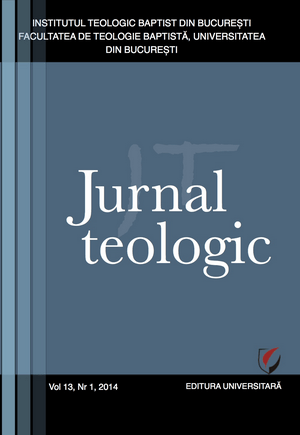
Jurnal teologic – Vol. 13, Nr. 1 / 2014
Vezi aici
COLDA, Teodor-Ioan. ‘Utopia libertății religioase în România postbelică. Baptiștii din România în perioada de tranziție de la Monarhie la Republică (1945-1953) II / The Utopia of Religious Freedom in Postbelic Romania. Romanian Baptists in transition from Monarchy to Republic (1945-1953) II.’ Jurnal teologic Vol 13, Nr 1 (2014): 157-189.
Baptist Theological Institute of Bucharest; Academic Visitor Attached to Ballioll College, University of Oxford
Abstract
In this paper the author tries to give a fair description and interpretation of the life of Baptist Churches in the period of transition from Monarchy to Republic in postbellic Romania, based on many unprecedented archive documents. The main focus of the paper is the problem of religious freedom in this very shifty period. Because of the persecution endured between the two world wars and during the nationalist and fascist regime of Antonescu, the self proclaimed absolute leader of Romania between 1940 and 1944, the Romanian Baptists tried to cope with the new situation established in their country at the end of the war, which seemed to be far better than before. Religious freedom was granted for all, first by His Royal Majesty King Michael and afterwards by the communists who managed to force the King into exile and transformed Romania into a republic. Though the communists were granting religious freedom through a new constitution they weren’t really committed to the idea of freedom, because of their proletarian revolutionary believes. This reluctance to offer religious freedom was encouraged by historical precedents in which the Orthodox Church managed to drive the state into a sinister partnership of persecuting those who were considered sects, dangerous for an Orthodox nation. In these circumstances, and tired from being persecuted, Baptist leaders and Baptist churches were forced into an unusual relationship with the communists. First it seemed that there couldn’t be any wrong or any danger in having a relationship with the state which is willing to grant religious freedom even for religious minorities. But in an atheistic and communist state religious freedom becomes a utopia.
Keywords: Baptist, Orthodox, Church, State, Persecution, Communism, Second World War
Celelalte articole din jurnal sunt:
SABOU, Sorin. ‘Human Nature and Moral Principles.’ Jurnal teologic Vol 13, Nr 1 (2014): 5-16.
BABAN, Octavian. ‘„Cuvântul este aproape de tine“: teologia invocării cerului și mării ca martori ai credinței și ai prezenței divine / The Word is Near You: The Theology of Invoking the Heavens and the Sea as Witness of Faith and Divine Presence.’ Jurnal teologic Vol 13, Nr 1 (2014): 17-43.
BARTOȘ, Emil. ‘Note apologetice despre învierea trupească / Apologetical Notes on Bodily Resurrection.’ Jurnal teologic Vol 13, Nr 1 (2014): 44-79.
SCHEETZ, Jordan M. ‘Cannonical Approaches, New Trajectories, and the Book of Daniel.’Jurnal teologic Vol 13, Nr 1 (2014): 81-110.
SWEIS, Khaldoun. ‘Is a Fetus a Human Person?: Thinking Deeply on a Complex and Politically Charged Question.’ Jurnal teologic Vol 13, Nr 1 (2014): 111-127.
RUSU, Timotei. ‘Amenințări laice ale conducerii bisericii / The Secular Threats upon the Church Government.’ Jurnal teologic Vol 13, Nr 1 (2014): 129-155.
GHIOANCĂ, Constantin. ‘Predicarea expozitivă și relevanța ei contemporană / Expository Preaching and its Contemporary Relevance.’ Jurnal teologic Vol 13, Nr 1 (2014): 191-205.
FRANDEȘ, Dorin. ‘Sonorul: un aspect marginalizat în lectura și predicarea Bibliei / Sound: a Marginalized Issue in the Reading and Preaching of the Bible.’ Jurnal teologicVol 13, Nr 1 (2014): 207-217.
Partajează asta:

Revista Creștinul Azi Nr. 3/2014
Click pe imagine pentru a răsfoi revista online









 Istorie Evanghelica