Billy Graham în Coreea comunsită
La începutul anilor ’90, Billy Graham a realizat o campanie evanghelistică și în Coreea de Nord unde a vorbit studenților de la Universitatea Kim Il Sung din Phenian. Spre deosebire de vizita din România în Coreea acesta a fost primit și de președintele țării.
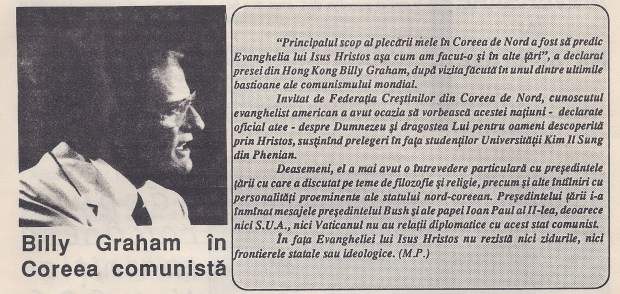
Revista Creștinul Azi, Nr.6-7, mai-iunie 1992, p.26
Partajează asta:

50 de ani de radio crestin in limba romana prin Trans World Radio
1961-2011
50 de ani de radio crestin in limba romana prin Trans World Radio
Pentru toate Bisericile evanghelice din Romania, ascultatori, sustinatori si parteneri, TWR Romania declara anul 2011 an jubiliar de multumire inaintea Domnului.
In 1961, intr-o perioada de avant ateist comunist si presiune anticrestina, incepeau sa se transmita pe Unde Scurte de la statia Monte Carlo primele emisiuni crestine de radio in limba romana. Datorita lipsei acute de Biblii si literatura crestina din acea perioada, aceste emisiuni au reprezentat o mare binecuvantare pentru romanii iubitori de Dumnezeu in general si pentru credinciosii evanghelici in particular.
In marea Sa dragoste pentru copiii Sai, Dumnezeu a facut posibil, prin mari eforturi de daruire umana si materiala a acelei generatii de credinciosi, ca statia de mare putere din Monte Carlo sa fie cumparata si echipata sa transmita Evanghelia pentru popoarele de dincolo de Cortina de fier.
Am fost uimit sa aflu in timpul documentarii pentru serbarea de 40 de ani din 2001 de la Bucuresti, ca aceasta statie de radio a fost construita de Hitler pentru propaganda nazista, dar el nu a folosit-o niciodata. Aunci Domnul mi-a indreptat gandul la realitatea cuvintelor psamului 2 versetul 4: „Cel ce sade in ceruri rade, Domnul Isi bate joc de ei”.
Avem un nou prilej de bucurie si sarbatoare, de a pune din nou o piatra de aducere aminte a binecuvantarilor lui Dumnezeu pentru natiunea noastra si de a-I multumi pentru toti acesti ani de har.
Asadar frati si surori din biserici mai mici sau mai mari, opriti–va cel putin o data in Noul an sa multumiti Domnului, gandindu-va la maretia Lui si la multimea binecuvantarilor pe care le-a daruit prin mesajul Evangheliei pe unde radio in toti acesti 50 de ani. Atat de multi credinciosi au fost intariti in credinta lor si foarte multi oameni au fost adusi la credinta mantuitoare in Domnul Isus Hristos. Noi stim doar o parte a lor, numai Domnul ii stie pe toti acestia.
Continuarea aici.
Partajează asta:

La vremuri noi, tot noi, dar cu noua conducerea a Cultului Penticostal
După zbateri și dezbateri penticostalii și-au ales o nouă conducere după zicala: La vremuri noi, tot noi. Anunțul este adus la cunoștința publicului printre alții și de către Emanuel Conțac care, ca și lingvist , prezintă noua conducere a Cultului Penticostal printr-un titlu interesant ,,Habemus papam!”. Am spus interesant, deoarece acesta face trimitere la un alt registru al relațiilor administrative, precum cele din interiorul Bisericii Catolice. Pentru detalii vezi și comentariile la articolul Habemus papam! precum și cele de pe Suceava Evanghelică. Personal am remarcat punctul de vedere al lui Alin Cristea referitor la utilizarea noilor mijloace informatice în procesul alegerilor, însă nedorind să influențez opinia dumneavoastră vă las plăcerea de a descoperii sau comenta singuri ceea ce vă interesează. Cât privește alegerile, de parcă până acum discutasem despre altceva :), anunțul de pe site-ul Vaisiamar sună astfel:
În urma alegerilor desfășurate la Congresul Național al Cultului organizat la Bistriţa [vineri 19.11.10], au fost desemnate persoanele care vor ocupa funcțiile de președinte (Pavel Riviş Tipei), vicepreședinte (Ioan Gurău), respectiv secretar (Romu Mocan).
În Consiliul Bisericesc apar nume noi: Ioan Filip şi Florin Ianovici.Sursa Vaisiamar
Iată și o poză cu noua conducere a Cultului Penticostal

Componenta noii conduceri a Cultului Penticostal nov. 2010

Conducerea Cultului Penticostal aleasă la Congresul Național de la Bistrița 19 nov. 2010
Suceava Evanghelică via România Evanghelică
Partajează asta:


Saving the World? The Changing Terrain of American Protestant Missions, 1910 to the Present

Organized by the Institute for the Study of American Evangelicals at Wheaton College and hosted by Duke Divinity School, this two-day conference on March 24-25, 2011 will explore the evolving nature of American Protestant missions since the famed Edinburgh Missionary Conference of 1910. Follow this link to read a summary of the project and watch a short video about it here.
Participants include: Thomas Kidd (Baylor University), Mark Noll (University of Notre Dame), Robert Priest (Trinity Evangelical Divinity School), Dana Robert (Boston University), Brian Stanley (University of Edinburgh), Grant Wacker (Duke Divinity School)
More informations here
Partajează asta:

Ellis Potter susține la Cluj ciclul de conferințe pe tema: Creștinism, Budism și New Age

Ciclul de conferințe va fi susținut la Biserica Teofania din Cluj-Napoca
Știre preluată de pe site-ul România Evanghelică
Partajează asta:

Papa Benedict lauda stiinta, dar insista ca Dumnezeu a creat lumea.
„Stephen Hawking greseste”, declara Papa Benedict al XVI-lea, care sustine ca Dumnezeu a creat universul. Celebrul om de stiinta a argumentat intr-o carte publicata luna trecuta ca Universul a luat nastere datorita actiunii spontane si inevitabile a legilor fizicii, iar Divinitatea nu a avut niciun rol in acest proces de creatie. De fapt, Papa Benedict a laudat si binecuvantat stiinta si oamenii de stiinta intr-un mesaj adresat Academiei Pontificale de Stiinte. Dar el a subliniat pe de alta parte, destul de clar, ca rolul stiintei este acela de „a-l descoperi” pe Dumnezeu in Univers. „Oamenii de stiinta nu creeaza lumea; ei o studiaza si incearca sa o imite”, a spus Papa. Observatiile si perceptiile „ne determina sa admitem existenta unei „Ratiuni atotputernice”, diferita de cea a oamenilor si care face posibila existenta acestei lumi”, transmite CNN.
Știre preluată de pe site-ul HotNews.ro
Partajează asta:
Teodor Baconschi – Creștinism și democrație
Teodor Baconschi, actualul ministru al afacerilor externe și-a lansat recent prin intermediul Fundației Creștin Democrate, cartea Creștinism și democrație. Despre aceasta, autorul spunea că nu reprezintă o producție nouă, ci mai degrabă o selecție de articole publicate în ultimii doi, trei ani. Lucrarea menționată a apărut la Editura Curtea Veche în cadrul colecției Democraţia creştină – serie coordonată de Mihai Neamţu şi Adrian Papahagi.
Teodor Baconschi este diplomat, om politic şi eseist. S-a născut la 14 februarie 1963, la Bucureşti, ca fiu al scriitorului A.E. Baconsky.
A fost ambasador pe lângă Sfântul Scaun (1997-2001), în Portugalia (2002-2005) şi Franţa (2007-2009), precum şi director general (2001-2002) şi secretar de stat (2005-2006) în Ministerul Afacerilor Externe. Între lunile octombrie 2006 şi august 2007, a fost consilier prezidenţial.
Din decembrie 2009, este Ministrul Afacerilor Externe.
În luna iunie 2010, a înfiinţat Fundaţia Creştin-Democrată, al cărei preşedinte-fondator este.
Teodor Baconschi este doctor al Universităţii Paris IV-Sorbona şi comandor al Legiunii de Onoare (Franţa).
Publicaţii (selectiv): Le Rire des Pères. Essai sur le rire dans la patristique grecque (Desclée de Brouwer, 1996), în traducere română: Râsul Patriarhilor. O antropologie a deriziunii în patristica răsăriteană (Anastasia, 1996); Iacob şi îngerul. 45 de ipostaze ale faptului religios (Anastasia, 1996); Ispita Binelui. Eseuri despre urbanitatea credinţei (Anastasia, 1999); Puterea schismei. Un portret al creştinismului european (Anastasia, 2001); împreună cu Horea Bernea: Roma Caput Mundi. Un ghid subiectiv al Cetăţii Eterne (Humanitas, 2001); Insula Cetăţii. Jurnal parizian (Curtea Veche, 2005); Despre necunoscut (Humanitas, 2007); Turn înclinat (Curtea Veche, 2007); Pe ce lume trăim? (Editura Fundaţiei PRO, 2007); 111 incursiuni în Cotidianul românesc (Curtea Veche, 2009).
Informațiile despre autor sunt preluate de pe site-ul Editurii 
Partajează asta:

Maxime și cugetări- Libertatea
Cine ştie că libertatea e bunul suprem înţelege ce poate însemna creştinismul.
Nicolae Steinhardt
Partajează asta:
Robert Fisk: Exodus. The changing map of the Middle East
From Israel to Iraq, a Christian flight of Biblical proportions has begun.
In the centre of the rebuilt Beirut, the massive old Maronite Cathedral of St George stands beside the even larger mass of the new Mohammad al-Amin mosque.
The mosque’s minarets tower over the cathedral, but the Maronites were built a spanking new archbishop’s house between the two buildings as compensation. Yet every day, the two calls to prayer – the clanging of church bells and the wailing of the muezzin – beat an infernal percussion across the city. Both bells and wails are tape recordings, but they have been turned up to the highest decibel pitch to outdo each other, louder than an aircraft’s roar, almost as crazed as the nightclub music from Gemmayzeh across the square. But the Christians are leaving.
GETTY IMAGES
A cross is decorated with lights as an Orthodox Christians in the
northern Iraqi city of Arbil commemorate the Elevation of the
Holy Cross on September 13, 2010,
Across the Middle East, it is the same story of despairing – sometimes frightened – Christian minorities, and of an exodus that reaches almost Biblical proportions. Almost half of Iraq’s Christians have fled their country since the first Gulf War in 1991, most of them after the 2004 invasion – a weird tribute to the self-proclaimed Christian faith of the two Bush presidents who went to war with Iraq – and stand now at 550,000, scarcely 3 per cent of the population. More than half of Lebanon’s Christians now live outside their country. Once a majority, the nation’s one and a half million Christians, most of them Maronite Catholics, comprise perhaps 35 per cent of the Lebanese. Egypt’s Coptic Christians – there are at most around eight million – now represent less than 10 per cent of the population.
This is, however, not so much a flight of fear, more a chronicle of a death foretold. Christians are being outbred by the majority Muslim populations in their countries and they are almost hopelessly divided. In Jerusalem, there are 13 different Christian churches and three patriarchs. A Muslim holds the keys to the Church of the Holy Sepulchre to prevent Armenian and Orthodox priests fighting each other at Easter.
When more than 200 members of 14 different churches – some of them divided – gathered in Rome last week for a papal synod on the loss of Christian populations in the lands where Christianity began, it was greeted with boredom or ignored altogether by most of the West’s press.
Yet nowhere is the Christian fate sadder than in the territories around Jerusalem. As Monsignor Fouad Twal, the ninth Latin patriarch of Jerusalem and the second to be an Arab, put it bleakly, „the Israelis regard us as 100 per cent Palestinian Arabs and we are oppressed in the same way as the Muslims. But Muslim fundamentalists identify us with the Christian West – which is not always true – and want us to pay the price.” With Christian Palestinians in Bethlehem cut off from Jerusalem by the same Israeli wall which imprisons their Muslim brothers, there is now, Twal says, „a young generation of Christians who do not know or visit the Holy Sepulchre”.
The Jordanian royal family have always protected their Christian population – at 350,000, it is around 6 per cent of the population – but this is perhaps the only flame of hope in the region. The divisions within Christianity proved even more dangerous to their community than the great Sunni-Shia divide did to the Muslims of the Middle East. Even the Crusaders were divided in their 100-year occupation of Palestine, or „Outremer”, as they called it. The Lebanese journalist Fady Noun, a Christian, wrote a profound article from Rome last week in which he spoke of the Christian loss as „a great wound haemorrhaging blood”, and bemoaned both Christian division and „egoism” for what he saw as a spiritual as well as a physical emigration. „There are those Christians who reach a kind of indifference… in Western countries who, swayed by the culture of these countries and the media, persuade eastern Christians to forget their identity,” he wrote.
Pope Benedict, whose mournful visit to the Holy Land last year prompted him to call the special synod which ended in the Vatican at the weekend, has adopted his usual perspective – that, despite their difficulties, Christians of the „Holy Land” must reinvigorate their feelings as „living stones” of the Middle Eastern Church. „To live in dignity in your own nation is before everything a fundamental human right,” he said. „That is why you must support conditions of peace and justice, which are indispensable for the harmonious development of all the inhabitants of the region.” But the Pope’s words sometimes suggested that real peace and justice lay in salvation rather than historical renewal.
Patriarch Twal believes that the Pope understood during his trip to Israel and the West Bank last year „the disastrous consequences of the conflict between Jews and Palestinian Arabs” and has stated openly that one of the principal causes of Christian emigration is „the Israeli occupation, the Christians’ lack of freedom of movement, and the economic circumstances in which they live”. But he does not see the total disappearance of the Christian faith in the Middle East. „We must have the courage to accept that we are Arabs and Christians and be faithful to this identity. Our wonderful mission is to be a bridge between East and West.”
One anonymous prelate at the Rome synod, quoted in one of the synod’s working papers, took a more pragmatic view. „Let’s stop saying there is no problem with Muslims; this isn’t true,” he said. „The problem doesn’t only come from fundamentalists, but from constitutions. In all the countries of the region except Lebanon, Christians are second-class citizens.” If religious freedom is guaranteed in these countries, „it is limited by specific laws and practices”. In Egypt, this has certainly been the case since President Sadat referred to himself as „the Muslim president of a Muslim country”.
The Lebanese Maronite Church – its priests, by the way, can marry – understands all too well how Christians can become aligned with political groups. The Lebanese writer Sami Khalife wrote last week in the French-language newspaper L’Orient-Le Jour – the francophone voice of Lebanon’s Christians – that a loss of moral authority had turned churches in his country into „political actors” which were beginning to sound like political parties. An open letter to the Iranian president, Mahmoud Ahmedinejad, warning him to try to turn Lebanon into a „front line” against Israel, was signed by 250 Lebanese. Most of them were from the minority Christian community.
Nor can the church ignore Saudi Arabia, where Christianity is banned as a religion just as much as the building of churches. Christians cannot visit the Islamic holy cities of Mecca or Medina – the doors of the Vatican and Canterbury Cathedral are at least open to Muslims – and 12 Filipinos and a priest were arrested in Saudi Arabia only this month for „proselytism” for holding a secret mass. There is, perhaps, a certain irony in the fact that the only balance to Christian emigration has been the arrival in the Middle East of perhaps a quarter of a million Christian Filipino guest workers – especially in the Gulf region – while Patriarch Twal reckons that around 40,000 of them now work and live in Israel and „Palestine”.
Needless to say, it is violence against Christians that occupies the West, a phenomenon nowhere better, or more bloodily, illustrated than by al-Qa’ida’s kidnapping of Archbishop Faraj Rahho in Mosul – an incident recorded in the US military archives revealed on Saturday – and his subsequent murder. When the Iraqi authorities later passed death sentences on two men for the killing, the church asked for them to be reprieved. In Egypt, there has been a gloomy increase in Christian-Muslim violence, especially in ancient villages in the far south of the country; in Cairo, Christian churches are now cordoned off by day-and-night police checkpoints.
And while Western Christians routinely deplore the falling Christian populations of the Middle East, their visits to the region tend to concentrate on pilgrimages to Biblical sites rather than meetings with their Christian opposite numbers.
Americans, so obsessed by the myths of East-West „clashes of civilisation” since 11 September 2001, often seem to regard Christianity as a „Western” rather than an Eastern religion, neatly separating the Middle East roots of their own religion from the lands of Islam. That in itself is a loss of faith.