Invitație conferință pentru pastorii și cadrele didactice care predau religie baptistă
CĂTRE,
PASTORII CARE PREDAU RELIGIE BAPTISTĂ
ȘI TOATE CADRELE DIDACTICE CARE PREDAU RELIGIE BAPTISTĂ
Dragi colegi,
Departamentul pentru Învățământul Preuniversitar din cadrul Cultului Creștin Baptist vă invită să participați la Conferința profesorilor care predau disciplina Religie Baptistă.
DE CE ?
Cu siguranță vă surprinde această invitație la prima Conferință a profesorilor de Religie Baptistă. Știm că sunteți foarte ocupați de aceea am considerat oportun să vă expunem câteva motive pentru care ar trebui să participați :
-veți întâlni colegi din toată țara
-prin generozitatea conducerii Universității „Emanuel”, vom beneficia de toate facilitățile unui mediu creștin academic de excepție
-veți avea posibilitatea să interacționați cu ceilalți profesori care au aceeași arie de studiu/ preocupări
-veți beneficia de învățătură biblică sănătoasă în cadrul sesiunilor plenare/atelierelor pentru discuții libere
-împreună vom gândi proiecte educaționale pentru dinamizarea și eficientizarea educației creștine
-vom încerca să găsim răspunsuri adecvate la preocupările și întrebările pe care le aveți
-vom fi slujiți de cadre didactice cu experiență în sfera educației creștine
-va exista un cadru generos pentru încurajare, schimb de idei și inițative educaționale
UNDE ? UNIVERSITATEA „EMANUEL” ORADEA
CÂND ? 15-16 SEPTEMBRIE 2017. Sosirea participanților va fi vineri după-amiază și plecarea sâmbătă după masa de prânz
COST : 50 RON care include cazare/trei mese/ceai-cafea
10 RON pentru cei care nu doresc cazare și servirea meselor
ÎNSCRIERI până la data de 4 septembrie 2017 folosind linkul https://docs.google.com/forms/d/e/1FAIpQLSdR1OUvJFK1ZkGWPBmaSl9luw-B1Qf_PS93RPagUjFXd9G9Gg/viewform
sau să trimiteți următoarele date pe adresa de email saalexro@yahoo.com
Numele și prenumele Unitatea școlară telefon email Solicit cazare DA/NU
Pentru întrebări și alte informații puteți folosi adresa de email saalexro@yahoo.com sau tel. 0741084301(Alexandru Szucs)
Conferința se adresează pastorilor care predau Religie Baptistă și tuturor cadrelor didactice, inclusiv celor care predau în regim de plata cu ora Religie Baptistă (titulari sau suplinitori pe alte discipline, cadre didactice asociate, pensionari)
Director departament, Secretar departament,
pastor Daniel Bărnuț prof. Alexandru Szucs
Partajează asta:

Teofil Stanciu: Învățământul românesc n-a fost mai jos de atât
Învățământul românesc n-a fost mai jos de atât, iar dacă nu se întâmplă un miracol prin care inși precum cel ce se dă acum ministru să dispară definitiv din posturi cheie, atunci ceea ce urmează e foarte posibil să distrugă și rămășițele de bun-simț, normalitate, coerență și bune practici din sistem. Iar Laur și Laura ne vor însoți cu spectrul imbecilității lor până la îndobitocirea finală.
Partajează asta:
TGC : 5 ‘Fake News’ Stories People Believe About Early Christianity
“Fake news” isn’t a new phenomenon, though. There’s quite a bit of fake news out there regarding the person of Jesus, the origins of the church, and the development of the Bible. Even though such “news” has no factual basis, it’s believed by an uncomfortably large number of people.
Here’s a sampling of five leading stories
1. Jesus was married to Mary Magdalene.
Perhaps there’s no conspiracy theory about early Christianity more sensational and captivating than the claim that Jesus was married and had children. It’s not only fodder for books like The Da Vinci Code, but it seems to pop up again and again in the mainstream media.
2. The deity of Jesus wasn’t decided until the Council of Nicea in the fourth century.
Another widespread conviction is that Jesus was merely an ordinary human who was exalted to divine status by the council of Nicea. They then suppressed (and oppressed) all who insisted otherwise.
3. Christians didn’t have a ‘Bible’ until the time of Constantine.
Also making our top-five list is the oft-repeated claim that early Christians, at least for the first four centuries, didn’t have a Bible. They were reliant merely on ever-changing oral tradition. And this problem wasn’t resolved until Constantine commissioned the production of a Bible in the fourth century (containing only the books he preferred).
4. The ‘Gnostic’ Gospels like Thomas were just as popular as Matthew, Mark, Luke, and John.
Ever since the discovery of the so-called Gnostic Gospels at Nag Hammadi in 1945, it’s been popular to insist that these “lost” Gospels were once more popular than our canonical ones. During the first few centuries, we’re told, Christians read the Gospel of Thomas with equal (if not more) regularity than the books that made it into our Bibles.
This whole narrative has a clear purpose behind it: to convince people that all Gospels are pretty much the same, and no Gospel is more valid than another.
5. The words of the New Testament were radically changed and corrupted in the earliest centuries.
Rounding out our top-five fake news stories is the claim that the text of the New Testament has been so radically corrupted, edited, and changed that we can’t really know what the original authors said. Made famous by Bart Ehrman’s bestseller Misquoting Jesus, this story has been repeated ad infinitum.
But there’s no evidence for this level of radical corruption. Can we see scribal changes and mistakes in our New Testament manuscripts? Of course, but that’s true for every document of antiquity. The New Testament.
These five examples of “fake news” about early Christianity get repeated so often people believe they must be true. Just like in the political world, however, we need to carefully examine the facts before we repeat the claims.
https://www.thegospelcoalition.org/article/5-fake-news-stories-people-believe-about-early-christianity
Partajează asta:
The Gospel Coalition : 4 Reasons to Teach Church History to Teens
Far from being a stagnant collection of dates, movements, and odd-sounding names, the church’s past represents a treasure trove of God-exalting wisdom that helps us navigate the cultural realities of the present.
Here are four reasons parents, pastors, teachers, and youth workers should teach church history to teenagers.
1. Teen Christians belong to the church.
Church history is their history, too.
2. Church history gives teens a vision to live boldly for Christ.
The pages of church history are filled with teenagers who have leaned into that proverb’s truth. Studied carefully, these examples give today’s teens vision and inspiration to surrender to Christ.
3. Church history provides examples that help us navigate broken cultures.
Any broken cultural reality we might experience in the present has likely been recognized by those who have gone before us. Examples of God’s people throughout the ages are invaluable resources for discipleship, with particular usefulness for teenagers.
4. Teens are the church’s future leaders, and leaders need to engage church history.
From William Wilberforce’s lifelong battle to abolish the British slave trade to the zealous missionary strategies of John Calvin, William Carey, Lottie Moon, and Elisabeth Elliott, church history offers a sure foundation on which to continue God’s global work.
https://www.thegospelcoalition.org
Partajează asta:
Teme teologice prioritare în dialogul interconfesional – Interviu cu Conf. univ. dr. Emil Bartoș
Teme teologice prioritare în dialogul interconfesional a constituit subiectul interviului pe care Conf. univ. dr. Emil Bartoș l-a acordat istoricului Marius Silveșan.
Partajează asta:
Susținere teză de abilitare în teologie – Conf. univ. dr. Emil Bartoș
Conf. univ. dr. Emil Bartoș a susținut în data de 10 iulie 2017 la Facultatea de Teologie Catolică, Universitatea din București, teza de abilitare în teologie cu titlul : Teme teologice prioritare în dialogul interconfesional.
Comisia de examinare a fost formată din Prof. Univ. Dr. Wilhelm Dancă, Prof. Gheorghe Pătraru – Universitatea Alexandru Ioan Cuza din Iași și Prof. Ștefan Ilioae – Universitatea Babeș -Bolyai din Cluj.
Partajează asta:
Call for Applications (Courses): The Netherlands School for Inovative Education
An interesting announcement for those interested in studying outside the country:
The Netherlands School for Innovative Education based in Utrecht, the Netherlands, organizes courses, workshops, and other events in Amsterdam, Moscow, Vienna and other cities, on a broad range of topics (business, personal development, project management, marketing and other areas of business, communicational skills, foreign languages, IT etc.).
For a list of courses offered and application form see the link below
Partajează asta:
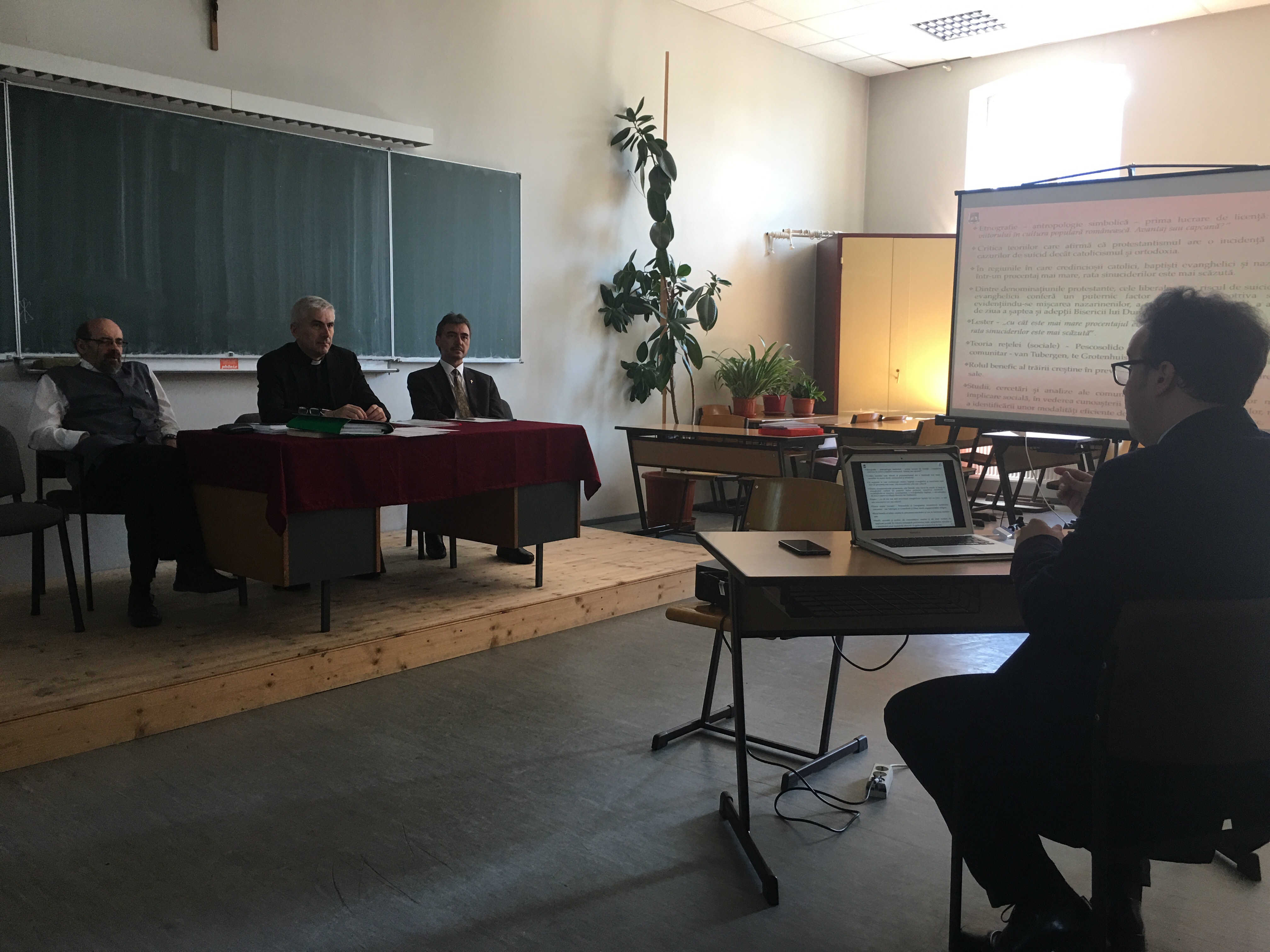
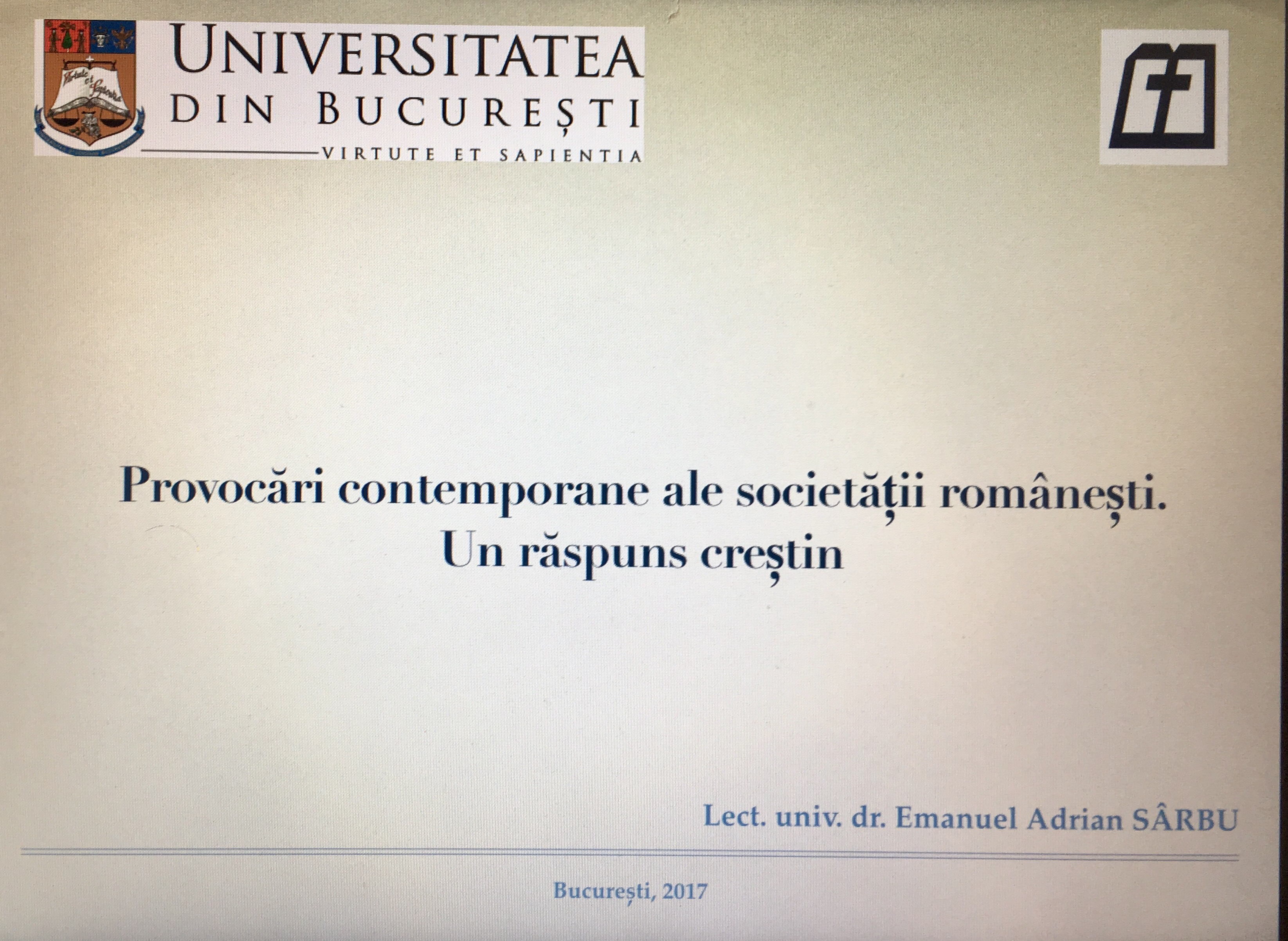
Lect. Univ. Dr. Emanuel Adrian Sârbu a susținut teza de abilitare: Provocări contemporane ale societății românești. Un răspuns creștin
La Facultatea de Teologie Catolică, Universitatea din București, Lect. Univ. Dr. Emanuel Adrian Sârbu a susținut teza de abilitare în teologie cu titlul : Provocări contemporane ale societății românești. Un răspuns creștin.
Comisia de examinare a fost formată din Pr. Prof. Univ. Dr. Wilhelm Dancă, Prof. Gheorghe Patraru – Universitatea Alexandru Ioan Cuza din Iasi și Prof. Ștefan Ilioae – Universitatea Babeș -Bolyai din Cluj.
Partajează asta:

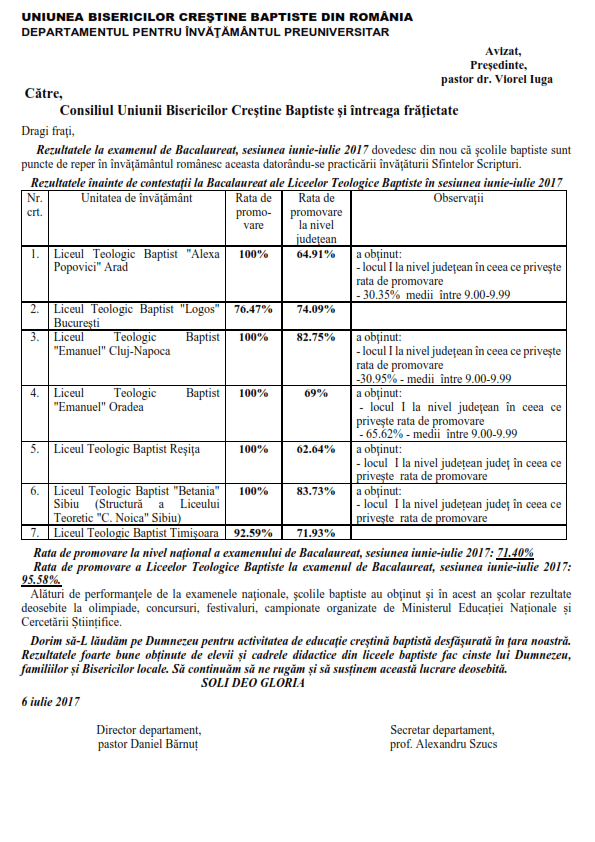
UBR : Comunicat al Departamentului de învățământ preuniversitar privind rezultatele la examenul de bacalaureat 2017 pentru liceele teologice baptiste
Un nou an, o nouă sesiune de bacalaureat cu rezultate bune pentru liceele baptiste.








 Istorie Evanghelica