Reforma Protestantă 500+. Trecut și viitor : Dezbatere la Biserica Adonai București (8 octombrie 2017)

Reforma protestantă este unul din elementele cruciale din istoria Bisericii creștine. Mișcarea evanghelică modernă, inclusiv cea din România își are o parte din rădăcini, dacă nu chiar întreaga rădăcină din Reforma inițiată de Martin Luther, în 1517.
Biserica Creștină Baptistă Adonai din București vă invită să asistați la o discuție-dezbatere pe tema Reformei. Cu acest prilej, spun organizatorii, ne vom aminti de lucrările lui Dumnezeu în trecut și vom privi la ce urmează pentru noi în viitor.
https://www.facebook.com/biserica.adonai/posts/1419128118199807
Acest eveniment are ca scop evocarea unui moment crucial din istoria modernă a lumii, Reforma Protestantă. Anul 2017 marchează 500 de ani de la acest eveniment, o perioadă care a adus cu sine schimbări în mai multe domenii, inclusiv, sau în primul rând, în cel religios.
Partajează asta:

Petru (Pitt) Popovici – 99 de ani
Astăzi, 12 septembrie 2017, fratele Pitt Popovici a împlinit frumoasa vârstă de 99 de ani și a plecat pe 100.
Dumnezeu să-l binecuvinteze.
Iată mai jos o scurtă biografie preluată de pe https://pittpopovici.wordpress.com/

Petru (Pitt) Popovici s-a născut la 12 septembrie 1918, la Harrisburg, Pennsylvania in Statele Unite. În 1921 s-a reintors in Romania împreuna cu frații și părintii sai, Simion si Zana Popovici. A studiat la Seminarul Teologic Baptist din București între anii 1937 – 1940. A păstorit bisericile baptiste Arad-Parneava (1945 – 1953) și Biserica Întaia Timișoara (1953 – 1967).
S-a reintors în Statele Unite în octombrie 1967, împreuna cu familia sa. În SUA a fost pastor sau copastor la bisericile din Chicago, Los Angeles, Sacramento și Atlanta. Programele lui religioase au fost transmise în Romania prin stațiile de radio cu unde scurte: HCJB Quito, Ecuador, TWR Monte Carlo, Monaco, IBRA Radio Lisabona, Portugalia, Radio European Crestin Ravena, Italia, Radio Europe Libera, Germania, Micul Samaritean Chișinau, Republica Moldova; iar pentru aria Los Angeles, Radio KTYM Inglewood, California. Petru Popovici este autorul a peste 40 de cărti și broșuri religioase.

Pitt și Hortensia Popovici în 1945
Căsătorit cu Hortensia Cristea, ei au sărbătorit 70 ani de căsătorie în 2015. În prezent el locuiește în aria Atlanta, Georgia, iar soția acestuia îl așteaptă în prezența Domnului.
Partajează asta:

Cristi Țepeș – evocare acțiuni de rezistență în comunism. Anul 1977
Partajează asta:

Resurse despre Constantin Adorian pe Istorie Evanghelica.ro
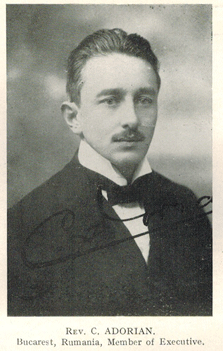
Pe site-ul istorieevanghelica.ro se resăsesc mai multe materiale despre Constantin Adorian, pe care le prezint mai jos în ordinea publicării acestora:
Ordinul secret al Maresalului Antonescu privind deportarea crestinilor evanghelici in Transnistria
Începuturile baptismului modern în România (II)
Începuturile baptismului modern în Romania (III). Constantin Adorian – Evanghelia trece la români
București, 1920 – Proiect : Palatul Evangheliei
Istorie Baptistă: Constantin Adorian – 1882-1954 – primul președinte al baptiștilor din România
Partajează asta:

Istorie Baptistă: Constantin Adorian – 1882-1954 – primul președinte al baptiștilor din România
Constantin Adorian a fost una dintre personalitățile baptiștilor din România în secolul XX, fiind primul președinte al Uniunii Baptiste, păstorul primei biserici baptiste române din Vechiul Regat, primul director al Seminarului Teologic Baptist după mutarea acestuia la București de la Arad în iarna anului 1921.
Am scris despre Adorian în lucrarea despre istoria Bisericilor Creștine Baptiste din România (1948-1965), dar și în alte lucrări, precum cea referitoare la istoria Seminarului Teologic Baptist.
Personalitatea și acțiunile sale merită cunoscute, fiind evidențiate de pastorul Vasile Bel care prezintă acum fragmente din istoria baptistă.
Citește articolul la adresa
https://istoriebaptistablogul.blogspot.ro/2017/09/constantin-adorian-1882-1954-primul.html
Partajează asta:

Pastorul Richard Wurmbrand, şef al Misiunii Bisericii Norvegiene „Magne Solheim” a înfiinţat şi organizat în anul 1947 mai multe reuniuni interconfesionale care aveau loc la Braşov
Secolul XX a oferit multiple ocazii de colaborare între cultele religioase din România. Un astfel de exemplu îl reprezintă și activitatea Misiunii Bisericii Norvegiene „Magne Solheim” și al pastorului Richard Wurmbrand.
Informația a fost regăsită de către doamna Mihaela Mihăilescu, fiind publicată în anul 2013 în cadrul unui articol despre Biserica Ortodoxă Română în timpul comunismului pe istorieculturala.ro.
Este scrisă astfel o altă filă din istoria Bisericii din România pe parcursul perioadei comuniste.
Un document [din Arhiva CNSAS (?)] referitor la vicarul patriarhal Antim Nica arată următoarele: pastorul Richard Wurmbrand, şef al Misiunii Bisericii Norvegiene „Magne Solheim” a înfiinţat şi organizat în anul 1947 mai multe reuniuni interconfesionale care aveau loc la Braşov. La ceste reuniuni participau şi preoţii Gâldău Florian (ulterior plecat în Anglia unde a ţinut conferinţe la Radio Londra), Gagiu Ion, Drăgulescu Toma şi episcopul Antim Nica (aflat în anul 1947 în fruntea eparhiei Dunării de Jos, în calitate de locotenent).
Durata acestor întruniri era de două săptămâni zi la zi consecutiv şi au avut loc două asemenea serii. Mai lămuritoare sunt notele făcute de ofiţeri de Securitate în „planul de acţiune informativă Antim Nica”, „ceea ce este mai important din activitatea lui, după 23 august 1944, este faptul că s-a stabilit informativ că Antim Nica a făcut parte din grupul de clerici ortodocşi români care erau în legătură cu organizaţia religioasă <<Mişcarea ecumenică internaţională>> demascată ca oficină de spionaj a serviciului secret american. Antim Nica era unul dintre conducătorii clericilor români care era în legătură cu această mişcare. De asemenea, s-a mai stabilit că Antim Nica era în foarte bune relaţii cu Magne Solheim, pastor evanghelic luteran norvegian, care iniţiase şi la noi în ţară, după 23 august 1944, o organizaţie de ajutorare a clericilor de toate confesiunile. Astfel Antim Nica în anul 1947 a mijlocit un mare ajutor ce s-a dat clericilor ortodocşi de către această organizaţie a lui Solheim. Şi această organizaţie a fost demascată ca oficină de spionaj a anglo – americanilor. Important[ă] este participarea lui Antim Nica în fruntea clericilor ortodocşi ce erau în legătură cu Mişcarea ecumenică internaţională precum şi faptul că nu întâmplător era în bune relaţii cu Solheim, demascat ca agent al spionajului american”.
Securitatea se arăta foarte interesată de activitatea mişcării ecumenice internaţionale şi de activitatea misiunii norvegiene, încercând blocarea colaborării Bisericii Ortodoxe Române cu aceste instituţii considerate agenturi imperialiste. De altfel, Biserica Ortodoxă Română a fost obligată să părăsească mişcarea ecumenică internaţională în anul 1948. Deoarece Securitatea considera colaborarea Bisericii Ortodoxe Române cu respectiva instituţie o cale de evaziune, care împiedica controlul strict al statului comunist asupra instituţiei eclesiastice în discuţie. La fel colaborarea cu alte culte cum este cazul Bisericii norvegiene a fost şi el interzis.
https://istorieevanghelica.ro/2016/12/31/biserica-ortodoxa-in-timpul-comunismului/
Partajează asta:
TGC : 5 ‘Fake News’ Stories People Believe About Early Christianity
“Fake news” isn’t a new phenomenon, though. There’s quite a bit of fake news out there regarding the person of Jesus, the origins of the church, and the development of the Bible. Even though such “news” has no factual basis, it’s believed by an uncomfortably large number of people.
Here’s a sampling of five leading stories
1. Jesus was married to Mary Magdalene.
Perhaps there’s no conspiracy theory about early Christianity more sensational and captivating than the claim that Jesus was married and had children. It’s not only fodder for books like The Da Vinci Code, but it seems to pop up again and again in the mainstream media.
2. The deity of Jesus wasn’t decided until the Council of Nicea in the fourth century.
Another widespread conviction is that Jesus was merely an ordinary human who was exalted to divine status by the council of Nicea. They then suppressed (and oppressed) all who insisted otherwise.
3. Christians didn’t have a ‘Bible’ until the time of Constantine.
Also making our top-five list is the oft-repeated claim that early Christians, at least for the first four centuries, didn’t have a Bible. They were reliant merely on ever-changing oral tradition. And this problem wasn’t resolved until Constantine commissioned the production of a Bible in the fourth century (containing only the books he preferred).
4. The ‘Gnostic’ Gospels like Thomas were just as popular as Matthew, Mark, Luke, and John.
Ever since the discovery of the so-called Gnostic Gospels at Nag Hammadi in 1945, it’s been popular to insist that these “lost” Gospels were once more popular than our canonical ones. During the first few centuries, we’re told, Christians read the Gospel of Thomas with equal (if not more) regularity than the books that made it into our Bibles.
This whole narrative has a clear purpose behind it: to convince people that all Gospels are pretty much the same, and no Gospel is more valid than another.
5. The words of the New Testament were radically changed and corrupted in the earliest centuries.
Rounding out our top-five fake news stories is the claim that the text of the New Testament has been so radically corrupted, edited, and changed that we can’t really know what the original authors said. Made famous by Bart Ehrman’s bestseller Misquoting Jesus, this story has been repeated ad infinitum.
But there’s no evidence for this level of radical corruption. Can we see scribal changes and mistakes in our New Testament manuscripts? Of course, but that’s true for every document of antiquity. The New Testament.
These five examples of “fake news” about early Christianity get repeated so often people believe they must be true. Just like in the political world, however, we need to carefully examine the facts before we repeat the claims.
https://www.thegospelcoalition.org/article/5-fake-news-stories-people-believe-about-early-christianity
Partajează asta:
The Gospel Coalition : 4 Reasons to Teach Church History to Teens
Far from being a stagnant collection of dates, movements, and odd-sounding names, the church’s past represents a treasure trove of God-exalting wisdom that helps us navigate the cultural realities of the present.
Here are four reasons parents, pastors, teachers, and youth workers should teach church history to teenagers.
1. Teen Christians belong to the church.
Church history is their history, too.
2. Church history gives teens a vision to live boldly for Christ.
The pages of church history are filled with teenagers who have leaned into that proverb’s truth. Studied carefully, these examples give today’s teens vision and inspiration to surrender to Christ.
3. Church history provides examples that help us navigate broken cultures.
Any broken cultural reality we might experience in the present has likely been recognized by those who have gone before us. Examples of God’s people throughout the ages are invaluable resources for discipleship, with particular usefulness for teenagers.
4. Teens are the church’s future leaders, and leaders need to engage church history.
From William Wilberforce’s lifelong battle to abolish the British slave trade to the zealous missionary strategies of John Calvin, William Carey, Lottie Moon, and Elisabeth Elliott, church history offers a sure foundation on which to continue God’s global work.
https://www.thegospelcoalition.org
Partajează asta:
Teme teologice prioritare în dialogul interconfesional – Interviu cu Conf. univ. dr. Emil Bartoș
Teme teologice prioritare în dialogul interconfesional a constituit subiectul interviului pe care Conf. univ. dr. Emil Bartoș l-a acordat istoricului Marius Silveșan.