Fotografii și scurte impresii de la lansarea în limba română a cărții „Excludere și îmbrățișare ” scrisă de Prof. Miroslav Volf
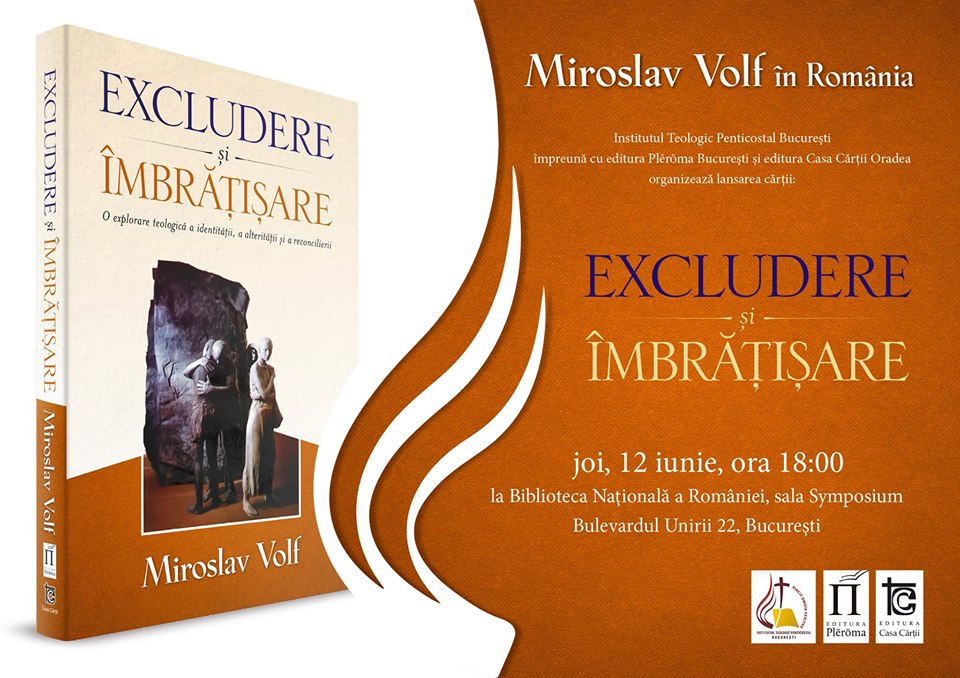
Joi, 12 iunie 2014 a avut loc la Biblioteca Națională a României lansarea cărții Excludere și îmbrățișare a Prof. Miroslav Volf. La acest eveniment au participat pe lângă autorul cărții, teologi și oameni de cultură. Dintre aceștia amintesc: Mihail Neamțu om de cultură, dar și om politic care a lansat o provocare Prof. Volf, dar și sălii: Ce se întâmplă atunci când refuzul îmbrățișării, adică excluderea, salvează viața unui om? Întrebarea are ca exemplu un caz real din România comunistă.
Alături de Mihail Neamțu la eveniment au mai participat profesorul universitar Corneliu Constantineanu, rectorul Institutului Teologic Penticostal din București care a adus în atenția audienței problematica cărții, a mulțumit Bibliotecii Naționale pentru deschiderea avută față de acest eveniment, fiind și moderatorul evenimentului.
Profesorul și teologul Silviu Tatu a fost traducătorul acestei întâlniri.
Am mai remarcat prezența lui Cristian Bădiliță, a profesorului Marcel Măcelaru, a traducătoarei, Mihaela Gingirov, a directorului Editurii Casa Cărții, Vasile Garbian, a editorilor Dragoș Ștefănică din partea Editurii Pleroma și a lui Teofil Stanciu din partea Editurii Casa Cărții.
La eveniment a fost prezent și Alin Cristea, jurnalist independent și editor al blogului România Evanghelică.
Cartea tratează problema iertării, a alterității, a culturii.
Partajează asta:

Lansare de carte: Miroslav Volf, Excludere și îmbrățișare (12 iunie 2014)
Joi, 12 iunie 2014, de la ora 18 la Biblioteca Națională a României se va lansa cartea Excludere și îmbrățișare scrisă de teologul Miroslav Volf.
Chiar dacă nu suntem de acord cu tot ce scrie acest teolog sau cu ideile lui asta nu înseamnă că trebuie să-l excludem din lecturile noastre.
Partajează asta:

Eugen Matei „Faptul că cineva prezintă ceva la o conferință academică nu înseamnă că noi toți trebuie să îi acceptăm toate ideile.”
Faptul că cineva prezintă ceva la o conferință academică nu înseamnă că noi toți trebuie să îi acceptăm toate ideile. Printre altele, acesta este rostul acestor evenimente: confruntarea de idei. Dacă ITP sau cultul penticostal nu are oameni care să dezvolte în studenți abilități de discernere între ce este de primit și ce nu, inclusiv dintr-o conferință ca cea cu Volf, situația este deplorabilă, pentru că studenții lor tot vor veni în contact cu ideile lui Volf – poate chiar mai interesați acum, din cauza controversei, și dacă e să piardă ceva, tot vor pierde. Din fericire, cred că ITP are oameni cu cap pe umeri, că altfel nu-l invitau pe Volf.
Evanghelicii români între ghetoizare și civilitate: Volf la ITP, crislamul și alte asemenea
Partajează asta:

Daniel Barbu despre sensul omului creștin
Partajează asta:

Jurnal teologic – Vol. 13, Nr. 1 / 2014
Vezi aici
COLDA, Teodor-Ioan. ‘Utopia libertății religioase în România postbelică. Baptiștii din România în perioada de tranziție de la Monarhie la Republică (1945-1953) II / The Utopia of Religious Freedom in Postbelic Romania. Romanian Baptists in transition from Monarchy to Republic (1945-1953) II.’ Jurnal teologic Vol 13, Nr 1 (2014): 157-189.
Baptist Theological Institute of Bucharest; Academic Visitor Attached to Ballioll College, University of Oxford
Abstract
In this paper the author tries to give a fair description and interpretation of the life of Baptist Churches in the period of transition from Monarchy to Republic in postbellic Romania, based on many unprecedented archive documents. The main focus of the paper is the problem of religious freedom in this very shifty period. Because of the persecution endured between the two world wars and during the nationalist and fascist regime of Antonescu, the self proclaimed absolute leader of Romania between 1940 and 1944, the Romanian Baptists tried to cope with the new situation established in their country at the end of the war, which seemed to be far better than before. Religious freedom was granted for all, first by His Royal Majesty King Michael and afterwards by the communists who managed to force the King into exile and transformed Romania into a republic. Though the communists were granting religious freedom through a new constitution they weren’t really committed to the idea of freedom, because of their proletarian revolutionary believes. This reluctance to offer religious freedom was encouraged by historical precedents in which the Orthodox Church managed to drive the state into a sinister partnership of persecuting those who were considered sects, dangerous for an Orthodox nation. In these circumstances, and tired from being persecuted, Baptist leaders and Baptist churches were forced into an unusual relationship with the communists. First it seemed that there couldn’t be any wrong or any danger in having a relationship with the state which is willing to grant religious freedom even for religious minorities. But in an atheistic and communist state religious freedom becomes a utopia.
Keywords: Baptist, Orthodox, Church, State, Persecution, Communism, Second World War
Celelalte articole din jurnal sunt:
SABOU, Sorin. ‘Human Nature and Moral Principles.’ Jurnal teologic Vol 13, Nr 1 (2014): 5-16.
BABAN, Octavian. ‘„Cuvântul este aproape de tine“: teologia invocării cerului și mării ca martori ai credinței și ai prezenței divine / The Word is Near You: The Theology of Invoking the Heavens and the Sea as Witness of Faith and Divine Presence.’ Jurnal teologic Vol 13, Nr 1 (2014): 17-43.
BARTOȘ, Emil. ‘Note apologetice despre învierea trupească / Apologetical Notes on Bodily Resurrection.’ Jurnal teologic Vol 13, Nr 1 (2014): 44-79.
SCHEETZ, Jordan M. ‘Cannonical Approaches, New Trajectories, and the Book of Daniel.’Jurnal teologic Vol 13, Nr 1 (2014): 81-110.
SWEIS, Khaldoun. ‘Is a Fetus a Human Person?: Thinking Deeply on a Complex and Politically Charged Question.’ Jurnal teologic Vol 13, Nr 1 (2014): 111-127.
RUSU, Timotei. ‘Amenințări laice ale conducerii bisericii / The Secular Threats upon the Church Government.’ Jurnal teologic Vol 13, Nr 1 (2014): 129-155.
GHIOANCĂ, Constantin. ‘Predicarea expozitivă și relevanța ei contemporană / Expository Preaching and its Contemporary Relevance.’ Jurnal teologic Vol 13, Nr 1 (2014): 191-205.
FRANDEȘ, Dorin. ‘Sonorul: un aspect marginalizat în lectura și predicarea Bibliei / Sound: a Marginalized Issue in the Reading and Preaching of the Bible.’ Jurnal teologicVol 13, Nr 1 (2014): 207-217.
Partajează asta:

Albert Mohler, Jr. — There is no ‘Third Way’ on the church’s teaching regarding the same-sex behaviors and relationships

Partajează asta:

Interviu cu Virgil Achihai la Alfa Omega TV despre obiectivele și viziunea Alianței Evanghelice din România
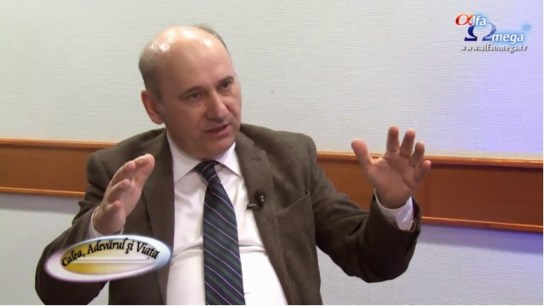
Pentru a urmări interviul dați click pe imagine.
Informație preluată prin intermediul lui Bogdan Emanuel Răduț
Pastorul Virgil Achihai este președintele în exercițiu al Alianței Evanghelice din România și al Uniunii Bisericilor Creștine Evanghelice din România.
În cadrul acestei emisiuni, pastorul Virgil Achihai amintește de rolul pe care eroii credinței l-au avut în promovarea valorilor creștine, în transportul bibliilor și a altor cărți religioase evanghelice.
Partajează asta:

Alin Cristea „Adevărul nu-și schimbă natura în funcție de context…”
Adevărul nu-și schimbă natura în funcție de context…
Contextul își schimbă semnificația în funcție de… adevăr.
Partajează asta:

9 THINGS YOU SHOULD KNOW ABOUT JOHN CALVIN
JOE CARTER for The Gospel Coalition.org
27 may 2014 marked the 450th anniversary of the death of John Calvin. Here are nine things you should know about the French theologian and Reformer.

1. From an early age, Calvin was a precocious student who excelled at Latin and philosophy. He was prepared to go to study of theology in Paris, when his father decided he should become a lawyer. Calvin spend half a decade at the University of Orleans studying law, a subject he did not love.
2. Calvin wrote his magnum opus, The Institutes of the Christian Religion, at the age of 27 (though he updated the work and published new editions throughout his life). The work was intended as an elementary manual for those who wanted to know something about the evangelical faith—”the whole sum of godliness and whatever it is necessary to know about saving doctrine.”
3. Calvin initially had no interest in being a pastor. While headed to Strasbourg he made a detour in Geneva where he met the local church leader William Farel. Calvin said he was only staying one night, but Farel argued that it was God’s will he remain in the city and become a pastor. When Calvin protested that he was a scholar, not a preacher, Farel swore a great oath that God would curse all Calvin’s studies unless he stayed in Geneva. Calvin later said, „”I felt as if God from heaven had laid his mighty hand upon me to stop me in my course—and I was so terror stricken that I did not continue my journey.”
4. Calvin was a stepfather (he married a widow, Idelette, who had two children) but had no surviving children himself. His only son, Jacques, was born prematurely and survived only briefly. When his wife died he wrote to his friend, Viret:
I have been bereaved of the best friend of my life, of one who, if it has been so ordained, would willingly have shared not only my poverty but also my death. During her life she was the faithful helper of my ministry. From her I never experienced the slightest hindrance.
5. During his ministry in Geneva, Calvin preached over two thousand sermons. He preached twice on Sunday and almost every weekday. His sermons lasted more than an hour and he did not use notes.
6. Around 1553, Calvin began an epistolary relationship with Michael Servetus, a Spanish theologian and physician. Servetus wrote several works with anti-trinitarian views so Calvin sent him a copy of his Institutes as a reply. Servetus promptly returned it, thoroughly annotated with critical observations. Calvin wrote to Servetus, „I neither hate you nor despise you; nor do I wish to persecute you; but I would be as hard as iron when I behold you insulting sound doctrine with so great audacity.” In time their correspondence grew more heated until Calvin ended it.
7. In the 1500s, denying the Trinity was a blasphemy that was considered worthy of death throughout Europe. Because he had written books denying the Trinity and denouncing paedobaptism, Servetus was condemned to death by the French Catholic Inquisition. Servetus escaped from prison in Vienne and fled to Italy, but stopped on the way in Geneva. After he attended a sermon by Calvin, Servetus was arrested by the city authorities. French Inquisitors asked that he be extradited to them for execution, but the officials in Geneva refused and brought him before their own heresy trial. Although Calvin believed Servetus deserving of death on account of what he termed as his „execrable blasphemies”, he wanted the Spaniard to be executed by decapitation as a traitor rather than by fire as a heretic. The Geneva council refused his request and burned Servetus at the stake with what was believed to be the last copy of his book chained to his leg.
8. Within Geneva, Calvin’s main concern was the creation of a collège, an institute for the education of children. Although the school was a single institution, it was divided into two parts: a grammar school called the collège and an advanced school called the académie. Within five years there were 1,200 students in the grammar school and 300 in the advanced school. The collège eventually became the Collège Calvin, one of the college preparatory schools of Geneva, while the académie became the University of Geneva.
9. Calvin worked himself nearly to death. As Christian History notes, when he could not walk the couple of hundred yards to church, he was carried in a chair to preach. When the doctor forbade him to go out in the winter air to the lecture room, he crowded the audience into his bedroom and gave lectures there. To those who would urge him to rest, he asked, „What? Would you have the Lord find me idle when he comes?”
Partajează asta:

Marius Silveșan, Prezentarea video a cărții „Cultele neoprotestante și drepturile omului” 6 aprilie 2014
În cadrul acestui articol public înregistrarea video realizată cu prilejul prezentării cărții Cultele neoprotestante și drepturile omului. Un strigăt la Radio Europa Liberă (aprilie 1977), ce a avut loc în cadrul evenimentului Credință și libertate organizat la Biserica Baptistă „Isus Mântuitorul” din București în data de 6 aprilie 2014.
Cu acel prilej am scris următoarele:
La 2 aprilie 1977 Radio Europa Liberă difuza un memoriu document semnat de către șase evanghelici: Iosif Țon, Pavel Nicolescu, Aurel Popescu, Silviu Cioată, Constantin Caraman, Radu Dumitrescu. Prin intermediul memoriului, atrăgeau atenția asupra persecuției religioase din România. Cunoscut și sub numele de Scrisoarea celor 6, acest memoriu este subiectul cărții pe care am realizat-o împreună cu istoricul Bogdan Emanuel Răduț – carte, pe care prin harul lui Dumnezeu, o voi prezenta duminică, 6 aprilie 2014, de la ora 18, în cadrul evenimentului Credință și libertate, alături de pastorul Florin Stoica și conferențiarul Cătălin Dupu.
Prin intermediul acestui articol doresc să remarc și faptul că prezentarea cărții a avut loc în 6 aprilie 2014 la o dată apropiată de citirea Scrisorii celor 6 la Radio Europa Liberă (2 aprilie 1977). Totodată, în 5 aprilie 2013 am avut lansarea oficială a cărții Bisericile Creștine Baptiste din România între persecuție, acomodare și rezistență: 1948-1965 când Cristi Țepeș, prezent la acel eveniment, a evocat faptul că se împlineau 36 de ani (1977-2013) de la acțiunea de protest a celor șase evanghelici români.
Orice informație care vine în completarea celor menționate în carte este binevenită.
Cartea Cultele neoprotestante și drepturile omului costă 15 lei și poate fi achiziționată de la autori.