Maxima zilei – 22 februarie 2016

Problema nu este ca toți să fie egali, ci ca toți să se iubească. Poți să fi bogat și să-i iubești pe ce-i sărăci, și să ai aceeași avere ca toți ceilalți și să-i urăști pe toți.
Lev Tolstoi, Despre Dumnezeu și om. Din jurnalul ultimilor ani (1907-1910), pp. 6-7.
Partajează asta:

București, 1920 – Proiect : Palatul Evangheliei
În anul 1920 pastorul baptist Constantin Adorian avea viziunea de a construi în București un Palat al Evangheliei. Conform informațiilor din această listă de subscripție localul urma a fi construit conform cerințelor moderne cu acustică și confort. În acest context se menționa că sala urma să aibă 2500 locuri pe scaune și balcoane.
În fața „catedralei va fi un mare baptisteriu de marmoră albă.” Clădirea urma să aibă lumină electrică și încălzire centrală, ceea ce nu era un lucru comun la momentul respectiv.
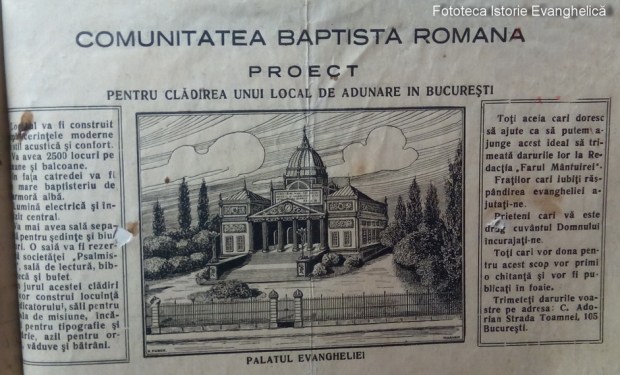
Informații suplimentare găsiți în cartea Constantin Adorian: un lider baptist vizionar scrisă de Daniel Marius Mariș și Teodor Ioan Colda.
Constantin Adorian a fost:
Pastorul fondator al primei biserici baptiste române din București, Biserica Baptistă“Golgota” (1912-1954)
Primul președinte al Uniunii Baptiste (1920-1925)
Primul director al Seminarului mutat la București (1921-1925)
Vicepreședintele Uniunii (1925-1927)
Președintele Cercului Baptist România Veche (1928-1931)
Președintele Uniunii Noi (1932-1933)
Vicepreședintele Uniunii (1937-1945, 1948-1954)
Directorul Seminarului (1940-1942)
https://romaniaevanghelica.wordpress.com/2015/06/02/constantin-adorian-1/
Partajează asta:

Maxima zilei – 16 februarie 2016
Prieteni dragi, rugați-vă Domnului să vă blagoslovească (binecuvânteze) dăruindu-vă bucuria.
Bucurați-vă ca niște copii, ca păsările văzduhului. Să nu vă înspăimânte ticăloșia oamenilor, nici să nu vă gândiți că v-ar putea zătnici în ostenelile voastre, zădărnicindu-vă truda. Să nu ziceți: „Vajnic este păcatul, aprigă ticăloșia și plină de vârtoșie răutatea ce ne înconjoară când noi suntem singuri și slabi. Răutatea lumii se va ridica stavilă în calea străduințelor noastre, osteneala și toată fapta bună nu vor fi de nici un folos”. Nu lăsați să biruie deznădejdea, feții mei !
F. M. Dostoievski, Frații Karamazov, vol. I, p. 547.
Partajează asta:

Maxima zilei – 11 februarie 2016

Cum se poate dezbăra de năravurile sale și unde poate să meargă cel care a căzut rob poftelor sale, de vreme ce s-a obișnuit să-și îndestuleze fără zăbavă atâtea nevoi pe care el însuși le-a scornit ? Ferecat cum este în singurătatea lui, nici nu-i mai pasă de ceilalți. Așa că oamenii au ajuns să agonisească o mulțime de bunuri, în schimb li s-au împuținat bucuriile.
Cu totul deosebit este drumul duhovniciei. Lumea își bate joc când aude de ascultare, de post de rugăciune, și totuși, ele sunt cărările ce duc spre adevărata libertate.
F. M. Dostoievski, Frații Karamazov, vol. I, pp. 536-537.
Partajează asta:

Video : Horia-Roman Patapievici, Partea nevăzută decide totul

Horia – Roman Patapievici într-o discuție la Digi 24 despre cartea Partea nevăzută decide totul
Vezi și
https://alonewithothers.wordpress.com/2016/01/18/astept-sa-oboseasca-nedreptatea/
Partajează asta:

Marius Corduneanu : Dacă nu ar fi luat în serios de mințile avide de teocrații laice, socialismul ar fi un bun studiu de caz clinic pentru filosofii dornici în a vedea cum o utopie plină de idei nobile poate eșua cu brio într-un imperiu al macabrului

Diego Riviera, The Arsenal (1928)
Dacă nu ar fi luat în serios de mințile avide de teocrații laice, socialismul ar fi un bun studiu de caz clinic pentru filosofii dornici în a vedea cum o utopie plină de idei nobile poate eșua cu brio într-un imperiu al macabrului. Din păcate până și filosofii s-au cam molipsit de boala care ar fi trebuit doar studiată! Nici nu mai înțeleg despre ce revoluție mai poate fi vorba când mai toți îs deja setați de revoluțiile socialiste? Cum ar fi o realitate monistă care-și trădează mereu caracterul dualist? Ce plictiseală ar fi în lumea în care socialismul nu ar avea țapi ispășitori, victime ceremoniale asupra cărora să-și verse toate frustrările funciare! Așadar, dragi camarazi, la arme sau pe arme?
https://alonewithothers.wordpress.com/2016/02/09/viva-la-revolucion-2/
Partajează asta:

The Gospel Coalition : 3 Ways Our Culture Is Different than Every Other Culture in History
We live in a turbulent cultural moment. The world around us is rapidly changing, and we face many challenges unprecedented in the history of the church. Augustine fought the Pelagians; Aquinas synthesized Aristotle; Luther strove with his conscience; Zwingli wielded an axe; but probably none of them ever dreamed of a world in which people could choose their gender. Secularizing late-modernity is a strange, new animal.
Identifying the historical and global isolation of our culture does not discredit it. “Weird” does not always equal “wrong.” Nonetheless, seeing ourselves in a broader perspective can go a long way toward humbling and opening us up to where Scripture wants to transform our thinking. I say “our” thinking because our first impulse in cultural critique shouldn’t be bashing others, but searching our own hearts. Since culture isn’t what we see but what we see through—the glasses, not the landscape—we’re often more “conformed to this world” (Rom. 12:2) than we realize.
Three Modern Eccentricities

Here are three ways our culture is eccentric in its basic instincts about God, morality, and life—ways we tend to see things differently not only than Solomon, Jesus, and Paul, but also Aristotle, the Aztecs, and Attila the Hun.
1. God is in the dock.
I’m currently writing my doctoral dissertation on Anselm (1033–1109). I’m always amazed by how exercised he was by the problem of divine mercy. Throughout his writings he labored over the question: how can a just and righteous God pass over sins and spare the undeserving?
Today we have the opposite problem. Divine mercy is assumed, and divine justice must be explained. How could a good and loving God ever judge people? (This is one of the top seven objections to Christianity Tim Keller tackles in The Reason for God.)
What’s so striking to me isn’t that Anselm and American culture have different answers, but that they’re asking different questions. For an 11th-century monk, it simply never occurred to him that God, rather than man, would be the one needing to be justified. C. S. Lewis captured this distinction well: “The ancient man approached God (or even the gods) as the accused person approaches his judge. For the modern man, the roles are quite reversed. He is the judge: God is in the dock.”
Perhaps the greatest example of this role reversal is the rise of atheism, a relatively rare phenomenon before the modern West. There are some scattered examples in pre-modern times of various kinds of materialism or agnosticism, but they’re strikingly sparse. For every one Lucretius or Democritus, you can find entire centuries and nations that know nothing but priests, monks, imams, lamas, shamans, sages, and sorcerers.
2. Morality is about self-expression.
In most cultures throughout history it was assumed that external reality is fixed—and that the basic point of life is to conform ourselves to it in some way. Buddha and Plato agree on this point; they only differ on what the conforming process looks like.
Our culture, by contrast, tends to exalt human desire and aspiration such that the point of life is for external reality to be conformed to it. To paraphrase Lewis: For the wise men of old the cardinal problem had been how to conform the soul to reality; today it’s how to subdue reality to the wishes of men.
In the late-modern West we’ve reduced truth to a personal construct and lost confidence in reason’s ability to access external reality. Thus the only foul in ethics is “harm,” and the only requirement for sexual behavior is “consent.” Basically, for many in our culture, you should be able to do anything you want so long as you don’t inhibit someone else’s self-expression.
Plato could have at least understood Buddha’s four noble truths. Buddha would have comprehended Plato’s advocacy for reason and justice. Both would be only perplexed and exasperated with the modern mantra “be true to yourself.”
3. Life is starved of transcendence.
In most ancient cultures, life and meaning were relatively stable. You didn’t have people like Albert Camus contemplating whether the absurdity of human existence necessitated suicide among the ancient Mongols, Mayans, or Vikings. As Brother Lippo Lippi put it in Robert Browning’s poem, “This world’s no blot for us, nor blank; it means intensely, and means good: to find its meaning is my meat and drink.”
Many today lack this sense of objective meaning; we are starved of transcendence, community, stability; we’re aching to find something big to live for; we feel listless, adrift, barren. Think of Nietzsche’s anguish in proclaiming the death of God in the late 19th century—in a milder, semiconscious way, this is how many feel today.
Our standard of living has risen, but so have our suicide rates; we are smarter, but more uncertain; surrounded with pleasure, but less fulfilled; able to do almost anything but uncertain whether to do anything.
I believe much of the sexual confusion and brokenness in our culture is the result of this deeper, existential void. We use things like sex and money to address basic questions of identity and fulfillment. As Kellerrecently observed, “In ancient cultures people had sex and made money to build a community; today, they do so to build an identity.” Or as Trevin Wax puts it, “One reason our culture is so sex-saturated is that we are so transcendence-starved.”
How Should We Respond?
Gospel faithfulness demands we engage our culture with both truth and love, yielding neither to compromise on the one side nor escapism on the other. This means we cannot simply bemoan the encroaching cultural darkness, swatting at the errors around us with our theological club. As TGC’sTheological Vision for Ministry puts it, “It is not enough that the church should counter the values of the dominant culture. We must be a counterculture for the common good.”
In responding to these metaphysical, ethical, and existential Copernican revolutions in our culture, I believe we must work hard to establish the corresponding subversive biblical doctrine in each of three areas: (1) a high view of God, (2) a thoroughgoing notion of repentance, and (3) a transcendent vision of worship.
1. God is transcendent.
2. Life comes through death.
3. Beholding God is our goal
http://www.thegospelcoalition.org
Partajează asta:

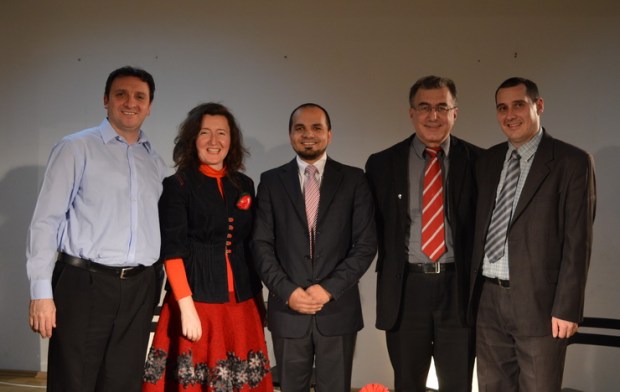
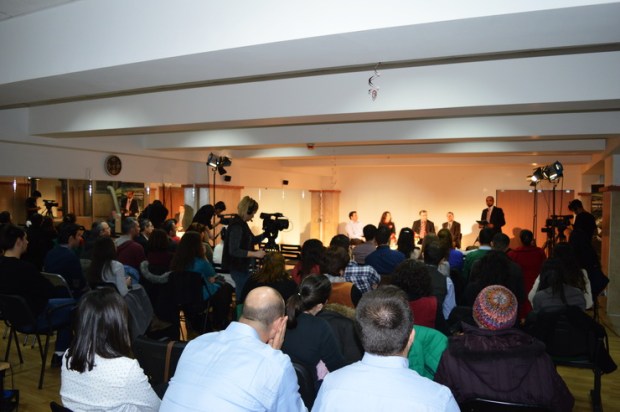
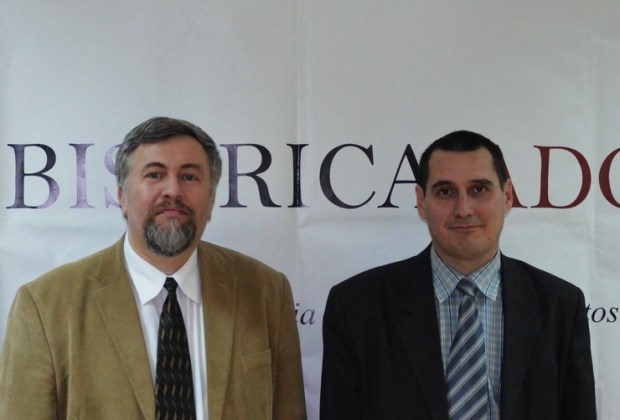
POZE: Dezbatere – Cazul Bodnariu: DE LA EI LA NOI
Poze realizate de Alin Cristea la dezbaterea privind educația copiilor într-o societate seculară.
*
*
*
*



Partajează asta:

Maxima zilei – 7 februarie 2016
Pretutindeni, în ziua de azi, mintea sceptică a omului a început să nu-și mai dea seama că adevărata chezășie a vieții nu poate fi dobândită numai prin străduințele lui, oricât s-ar osteni de unul singur, că pentru asta trebuie să se străduiască împreună, cu puteri unite.
F. M. Dostoievski, Frații Karamazov, vol. I, p. 517.
Partajează asta:

Maxima zilei – 6 februarie 2016
Omul s-a învățat să nu se mai bizuie decât pe mijloacele lui, și, răzlețindu-se de obște, a ajuns cu timpul să nu mai pună nici o nădejde în ajutorul semenilor, să nu mai creadă în oameni, nici în omenire, să tremure numai de teamă că s-ar putea cumva irosi agoniseala lui și deprinderile pe care le-a câștigat.
F. M. Dostoievski, Frății Karamazov, vol. I, p. 517